
How to make AI history videos that get the history right
Do the research before you prompt anything: find what the records say, write the script in your own words, and let AI draw the pictures and read the voice. This guide walks through it with our own Roswell video, checked against the US government's reports, and covers what YouTube and TikTok ask of AI history content as of 11 October 2026.
A history video is only as good as its sources
AI makes history videos quick to produce: a script in seconds, a picture for every scene, a voice to read it. That’s also the risk. Ask an AI to write about a famous event and it will repeat the most popular version of the story with total confidence, myths included, and a realistic AI picture of a real event can be taken for archive film.
History audiences notice. Get a date wrong and the comments will tell you, and every correction costs you trust you need for the next video. So the order matters: research first, then the script, then the pictures and the voice. AI is excellent at the last two. The first two are your job, and they’re what makes the channel yours.
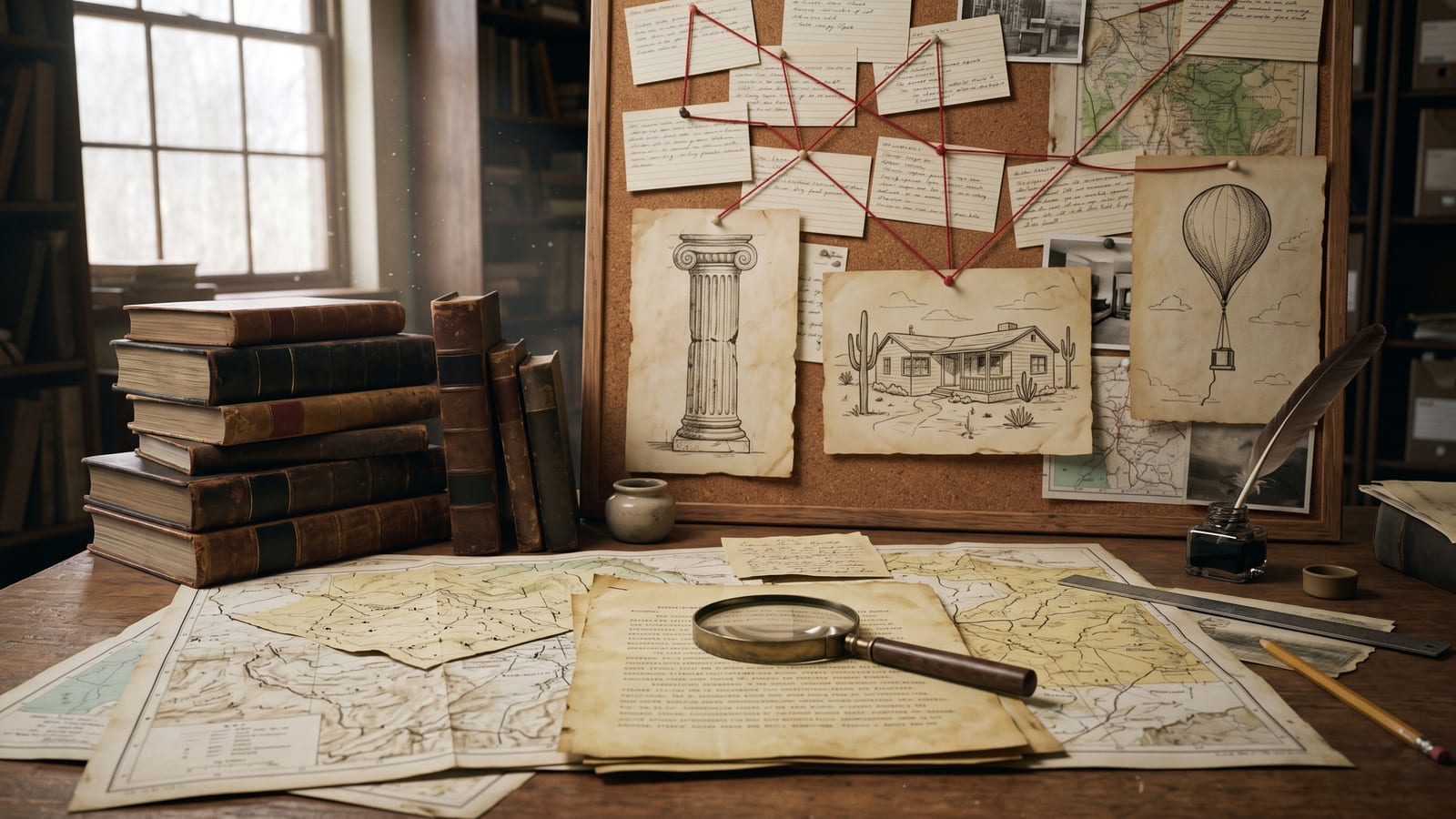
Step 1: research from primary sources, before any prompt
A primary source is a record made at the time by someone involved: a letter, an order, a press release, a unit’s own history. Official reports and good reference works come next. An AI’s summary, a forum thread or another channel’s video are where you find leads, never where you check them.
The US National Archives teaches four steps for reading any document: “Meet the document.” “Observe its parts.” “Try to make sense of it.” “Use it as historical evidence.” (National Archives). Keep a list of every source as you go; you’ll need it for the description.
Here’s how that played out for our video on Roswell. The popular story mixes events decades apart; the records separate them:
| Date | What the record says | Source |
|---|---|---|
| 8 July 1947 | Roswell Army Air Field’s press office announced the recovery of a “flying disc” | US GAO report, 1995 |
| 9 July 1947 | The press reported the Eighth Air Force’s commanding general saying it was a radar-tracking weather balloon | US GAO report, 1995 |
| July 1947 | The base’s own history: “The object turned out to be a radar tracking balloon.” | US GAO report, 1995 |
| 1994, published 1995 | The Air Force found the wreckage most likely came from Project Mogul, a classified effort to detect Soviet nuclear tests with balloons | The Roswell Report: Fact versus Fiction |
| 1997 | The Air Force traced reports of “alien bodies” to test dummies carried by high-altitude balloons in the 1950s, and to accidents in 1956 and 1959, not to anything in 1947 | The Roswell Report: Case Closed |
The GAO’s report adds the detail that keeps the mystery alive: some of the base’s records from 1945 to 1949 were destroyed, with nothing to say who destroyed them or why. That’s a true and interesting line for a script. “The government hid an alien crash” isn’t.
Step 2: write the script yourself, and say how sure you are
Write the words before anything is drawn, about 150 words for a minute. A good history script does three things AI scripts rarely do:
- It separates fact from claim. “The base announced a flying disc” is a fact. “A flying disc crashed” isn’t.
- It flags conventions. The fall of Rome is usually dated to 476, but Britannica says that date “is traditionally considered” the end of the Western Empire, the year Odoacer took power in Italy, and the Eastern Empire carried on until 1453 (Britannica). One extra word, “traditionally”, makes the line true.
- It ends honestly. A question for the comments (“So what do you think really happened?”) is fine; a question that implies the records say something they don’t isn’t.
Your own words matter for earning, too. YouTube’s monetisation policies exclude content that’s “mass-produced, generic, repetitive or manipulative”, including videos that only read out material you didn’t create.
Step 3: illustrate the past, don’t fake footage
The safest look for AI history is one that’s clearly a picture: illustration, painting, comic, woodcut, stained glass. It reads as storytelling, not evidence, and it changes what the platforms ask of you.
YouTube. Its disclosure rules ask creators to disclose AI content that “Alters footage of a real event or place” or “Generates a realistic scene that didn’t actually occur”. Non-realistic content doesn’t need it: YouTube’s own example is an AI animation “in a fully animated video”. YouTube may still add a label in the description itself, for instance when a file carries C2PA metadata, and disclosing won’t limit a video’s audience or its earnings. Separately, its hate speech policy bans denying or minimising well-documented major violent events.
TikTok. Its Community Guidelines, effective 24 September 2026, require a label on AI content that shows realistic-looking scenes or people, and don’t allow content that’s misleading about matters of public importance, labelled or not.
Then check every picture the way a pedant would: uniforms, vehicles, buildings, clothes, what’s written on signs. AI mixes centuries happily. Redraw anything that’s wrong; it’s cheaper than a comment section full of corrections.
How we made our Roswell video
We built BosOn’s Explainer Studio to take a story from the script to a finished video in one window, and Roswell is one we made with it. It follows the records above: the flying disc announcement, the balloon the next day, and Project Mogul as the explanation that stayed classified.
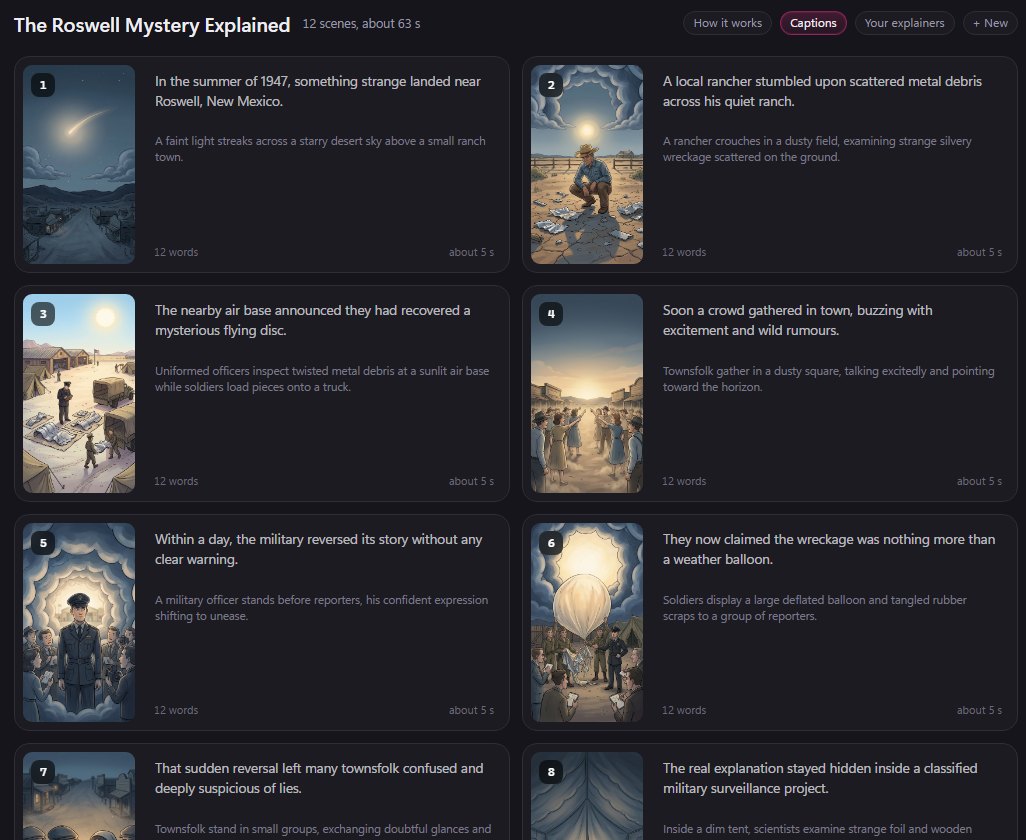
- Your own words, kept word for word. Choose Use my words and paste the script you researched; BosOn splits it into scenes without rewriting it. Or let it write a first draft, then Rewrite any line with a note.
- One illustrated look for the whole series, such as Ink and Wash, Stained Glass or Painted Cinematic, so the video reads as a story, not footage.
- Fix a picture before paying for clips. Redraw any scene that has the wrong uniform or the wrong century.
- A voice, captions and music, then a finished 1080p video, upright or wide.
Explainer Studio’s parts can be made on your Higgsfield plan, the Higgsfield API or your own Kie.ai key, each priced before you make it. BosOn is our desktop app for Windows and Mac, in early access; see what else it makes on our Create page, and our faceless YouTube guide for growing a channel around it.
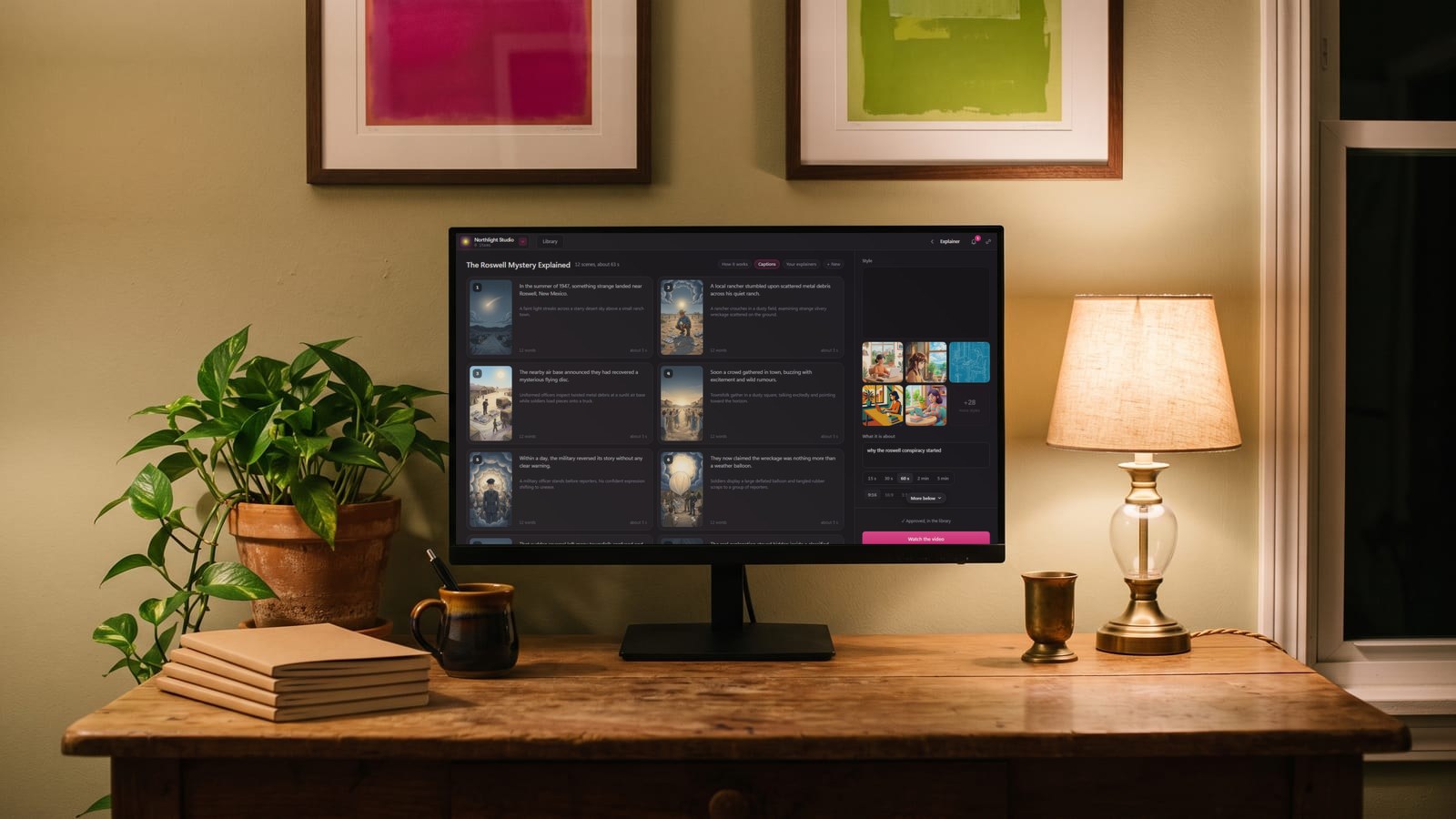
Step 4: show your sources, and correct in public
Put your sources in the description, with links where they exist: it’s the easiest way to earn a history audience’s trust, and it lets the curious go deeper. When someone spots a mistake, thank them, pin a correction, and fix the next video. Keep your research notes with the finished video too, so part two starts from what you already checked.
BosOn is independent and isn’t affiliated with or endorsed by YouTube or TikTok.
Questions people also ask
Do I need to label AI history videos on YouTube?
Only if they look real. YouTube asks creators to disclose AI content that alters footage of a real event or place, or generates a realistic scene that didn't actually occur. Non-realistic content, such as a fully animated video, doesn't need disclosing, though YouTube may still add a label in the description, for example from C2PA metadata.
Can AI history videos make money on YouTube?
Yes, if they're your own work. YouTube's monetisation policies exclude content that is mass-produced, generic or repetitive, such as AI content made from generic templates or videos that only read out material you didn't create. A history video you researched, wrote and narrated is the kind of content YouTube allows.
What really happened at Roswell in 1947?
On 8 July 1947 the Roswell Army Air Field announced it had recovered a 'flying disc'; the next day the press reported the Army saying it was a radar-tracking weather balloon. The US Air Force's 1994 findings, published in 1995, said the debris most likely came from Project Mogul, a classified programme using balloons to detect Soviet nuclear tests, and its 1997 report traced the 'alien bodies' stories to test dummies used in the 1950s.
How do I check historical facts for a video?
Go to primary sources, records made at the time by people involved, and to official reports and reputable reference works. The US National Archives teaches four steps for any document: meet it, observe its parts, try to make sense of it, and use it as evidence. Keep a list of every source you used and put it in the video's description.
Is it wrong to use AI for history videos?
No, as long as the history is right and the pictures don't pretend to be real footage. The risk is AI-written scripts that state myths as facts and realistic AI scenes that viewers take for archive film. Research the facts yourself, illustrate rather than fake, and label anything realistic.
Sources
- US GAO: Results of a Search for Records Concerning the 1947 Crash Near Roswell, New Mexico (NSIAD-95-187, 28 July 1995)
- Department of the Air Force History: The Roswell Report, Fact versus Fiction in the New Mexico Desert
- US Air Force: The Roswell Report, Case Closed (1997), text at Project Gutenberg
- US National Archives, The Unwritten Record: Roswell
- US National Archives: Document analysis worksheets
- Britannica: Odoacer
- Britannica: Byzantine Empire
- YouTube Help: Disclosing use of GenAI content
- YouTube Help: YouTube channel monetisation policies
- YouTube Help: Hate speech policy
- TikTok Community Guidelines: Integrity and authenticity (effective 24 September 2026)